My Blood Pressure Was Perfect For 30 Years. Then Menopause Came, And Nobody Explained Why It Climbed.
November 1, 2026 · A reader’s story


118/76. 120/78. For thirty years, that was me.
I never thought about my blood pressure. The nurse read the number, smiled, and moved on.
Then I turned 51.
138/88. Then 142/90.
Same walks. Same meals. Same me. A different number on the screen.
Hot flashes, I expected. Bad sleep, I expected. Nobody warned me about this.
If your numbers changed around menopause too, keep reading. What I learned takes five minutes, and I wish someone had told me sooner.
THE NUMBERS THAT CHANGED EVERYTHING

I started keeping my readings in my phone. Every morning. Same chair, same arm.
The note looked like this:
Before menopause: 118/76. 120/78.
Around menopause: 138/88. 142/90.
I checked the cuff. I checked my salt. I asked myself if it was stress, or a bad night.
At the bottom of the note, I typed one line: Same habits. Different numbers. Why did nobody tell me?
That question sent me looking for answers.
WHAT NOBODY EXPLAINED ABOUT MENOPAUSE

Here’s what I finally learned.
Estrogen helps blood vessels relax and widen. As estrogen drops during menopause, vessels can become less flexible.
Stiffer vessels. The same heart pushing the same blood.
That’s why blood pressure often climbs at this stage, even when your habits haven’t changed.
It wasn’t me. It was the change.

Think of a blood vessel as a soft garden hose. When the walls relax, water moves through easily. When they tighten, the pressure goes up.
So my question became: what helps vessels relax?
The Usual Checklist

Like you, I ran through everything.
Less salt. More walks. Cuff on the other arm. Sit for five minutes and check again.
All good habits. I kept every one.
But none of them told me what had changed inside my vessels, or what I could add.
THE ANSWER HIDING IN PLAIN SIGHT

The answer was two things I’d walked past at the grocery store my whole life.
Beetroot and hibiscus.
Beetroot is rich in nitrate. Hibiscus is a flower researchers have studied for blood pressure.
Each one works in its own way. And I had never had both on the same day.
HOW DOES BEETROOT HELP BLOOD VESSELS?
It happens in three simple steps.
1. Beetroot Gives Your Body Nitrate.
Your body absorbs the nitrate. Then bacteria in your mouth help turn it into nitrite.
2. Your Body Turns It Into Nitric Oxide.
Nitric oxide is a signal your body already uses. It tells the muscles in your vessel walls to loosen.
Relaxed vessels give blood more room to flow.
3. Hibiscus Adds Its Own Support.
Hibiscus has its own blood pressure research, separate from beet.
Two ingredients. Two different jobs.
WHY I COULDN’T KEEP IT UP AT FIRST

My first try was a mess.
Fresh beets stained my cutting board. The juicer took longer to clean than to use. Hibiscus tea meant boiling a kettle every morning.
By the second week, I’d skipped more days than I’d done.
If it isn’t easy, it doesn’t happen.
The Daily Drink That Made It Easy

Then I found Steadia Beetroot + Hibiscus. Both ingredients in one scoop:
- 1,375 mg beetroot
- 1,000 mg hibiscus flower
- 500 mg apple juice powder
One scoop in 6–8 oz of cold water. Stir. Drink within 10 minutes. That’s it.
No juicer. No kettle. No pills to swallow.
WHAT MY MORNINGS LOOK LIKE NOW

Glass. Cold water. One scoop. I drink it while my coffee brews.
Then I write my reading in my log, like always.
It takes less than a minute. It’s the easiest part of my day.

Denise W.
“My blood pressure kept creeping up and I did not want another pill. I drink this every morning now. Tastes like berry tea, not dirt!”
Lucia R.

“On my second jar. I love the taste and I like knowing I am doing something for my BP every single day.”
Barbara L.
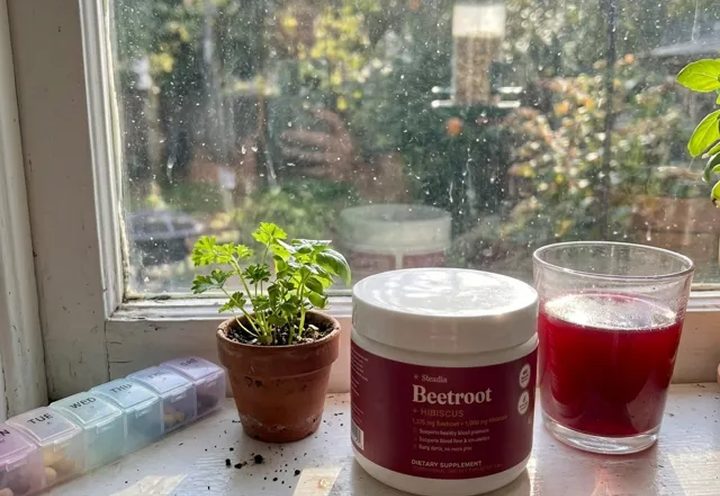
“It sits next to my pill box so I never forget it. Much better than the hibiscus tea I used to brew.”
What “Normal” Should Feel Like

Menopause changes enough already.
I wanted one simple thing I could do each morning. Something I understood, that fit my life.
Not another pill. Not another gadget. Just a drink with my breakfast.
WHY I WISH I’D STARTED SOONER
For months, I watched the numbers and wondered.
I kept the walks. I kept the low-salt meals. I just added the part I’d been missing: something to help my vessels relax.
If your numbers changed around menopause, you don’t have to wait for someone to explain it. Now you know.
Try Steadia With Your Morning Routine

Steadia Beetroot + Hibiscus. 30 servings per jar.
Subscribe and save 15%: $36.54 a jar, about $1.22 a day. Or buy once for $42.99.
Get 2 or 3 jars and the Daily Drink Guide + BP Reading Log is free, plus shipping protection.
Free shipping in the lower 48 US states. Skip or cancel anytime.
30-day refund on unopened jars.
Steadia Beetroot + Hibiscus · 30 servings per jar
A NOTE FROM THE JOURNAL
A change in blood pressure around menopause can leave you with questions. This reader’s story is here to make the change easier to understand.
Know what each ingredient is for. Read the amounts. Choose a routine that fits your day.
Dr. Helen Sutherland, Steadia’s reviewing doctor, shared this about Steadia’s approach:
“I appreciate what Steadia is doing to make supplement choices easier to understand. It’s an approach I’m happy to stand behind.”
Dr. Helen Sutherland · Steadia’s reviewing doctor
Menopause and blood vessels — British Heart Foundation
Beetroot’s nitrate pathway — research review
Hibiscus and blood pressure — research review


Understand The Change. Make Room For A Daily Drink.
Beetroot + hibiscus in one scoop. Mix with cold water once a day.

Comments